
For decades, asset service management operated on a predictable, albeit flawed, model: something breaks, a customer calls, and a technician is dispatched to fix it.
While previous discussions have explored how unified platforms consolidate operations, how connected data turns service into a profit center, how predictive maintenance eliminates unplanned downtime, and how intelligent tools bridge technician knowledge gaps, there is a broader operational shift taking place across the industry.
The convergence of Internet of Things (IoT) telemetry and Artificial Intelligence (AI) including natural language Copilots and autonomous agents, is fundamentally changing asset service management. Rather than merely streamlining workflows, these technologies convert physical equipment into real-time data streams, turning reactive repairs into automated, self-healing service ecosystems.
The Architectural Shift: From Connected Sensors to Autonomous Action
Integrating IoT into field service is no longer limited to basic sensor monitoring. Early implementations focused on simple telemetry, sending ambient temperature alerts or fault codes to a dashboard. Modern asset service management bridges real-time physical telemetry directly with intelligent operational execution.
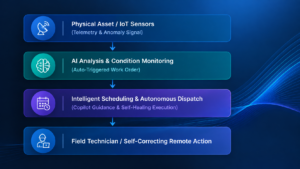
When an asset continuously streams health indicators (vibration, thermal expansion, flow resistance), AI models establish dynamic baselines. Instead of triggering alerts only when rigid thresholds are breached, machine learning algorithms detect subtle pattern anomalies days or weeks before a component fails.
Once an anomaly is identified, the system moves automatically from detection to resolution:
- Self-Registration & Diagnostics: The asset registers its own service incident, attaching historical diagnostic logs and specific telemetry readings.
- Remote Remediation (Self-Healing): AI agents attempt automated diagnostic scripts or firmware resets remotely before dispatching personnel.
- Automated Work Order Generation: If physical intervention is required, the system generates a structured work order populated with required parts, estimated labor duration, and safety protocols based on historical fix patterns.
Dynamic Dispatch: Moving Beyond Static Route Optimization
Traditional scheduling engines optimize routes based on static variables: geographic proximity, open calendars, and fixed job durations. However, real-world field conditions change constantly due to urgent breakdown requests, traffic delays, extended jobs, and last-minute part shortages.
AI-driven scheduling agents transform dispatching into an ongoing, dynamic optimization process.
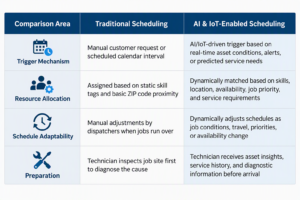
By evaluating schedule board changes in real time, AI agents automatically adjust routes, match technician expertise with asset-specific diagnostic requirements, and ensure parts are pre-allocated from truck stock or regional distribution centers.
Augmenting Field Technicians with Contextual AI & Copilots
Even with accurate diagnostics and optimal routing, the execution phase often faces obstacles. Aging equipment, complex machinery revisions, and retiring workforce expertise create knowledge gaps on site.
Generative AI and embedded Copilots help bridge this gap by converting institutional knowledge into immediate guidance at the point of service.
- Conversational Diagnostic Assistants: Field engineers no longer need to search through hundreds of pages of PDF manuals. Using natural language queries via mobile devices, technicians can ask Copilots to query technical documentation, schematics, and past resolution logs to generate concise step-by-step troubleshooting workflows.
- Automated Work Order Summarization: When taking over complex, multi-stage asset repairs, technicians receive AI-generated summaries covering past service events, recurring component failures, and customer communications.
- Hands-Free Field Capture: Technicians can dictate job notes, log replaced parts, and record work completion details via voice commands. AI agents structure this unstructured input into compliant service records and update inventory counts across enterprise systems (ERP/EAM) automatically.
Operational & Financial Impact across Industry Verticals
The integration of IoT telemetry and AI-driven automation delivers distinct operational benefits across asset-intensive sectors:
Manufacturing & Industrial Equipment
- Continuous Health Monitoring: Heavy machinery streams runtime data to identify bearing wear and thermal stress.
- Impact: Eliminates secondary asset damage caused by cascading component failures and extends overall equipment effectiveness (OEE).
Utilities & Infrastructure
- Grid & Network Monitoring: Distributed sensors track voltage irregularities, pressure changes, or pipe flow anomalies.
- Impact: Enables rapid fault isolation and automated technician dispatch to exact location coordinates, reducing repair times during critical outages.
Commercial Facilities & HVAC
- Environmental & System Telemetry: Building management systems stream performance metrics to monitor energy efficiency and compressor health.
- Impact: Replaces arbitrary calendar-based filter and fluid changes with condition-based maintenance, lowering maintenance overhead while optimizing energy consumption.
The Next Phase: Autonomous Asset Ecosystems
The integration of IoT and AI transforms field service management from a reactive repair model into a strategic business driver. Organizations shift focus from responding to emergency downtime to managing continuous asset performance and operational uptime.
By connecting asset telemetry directly to intelligent scheduling agents, guided mobile workflows, and integrated enterprise backends, businesses can establish field service operations that are proactive, self-optimizing, and resilient.
How Asset-Intensive Organizations Are Eliminating Unplanned Downtime with Predictive Maintenance