

Most asset failures don’t announce themselves. They build gradually: a vibration pattern shifting outside its normal range, a temperature reading climbing by degrees, a pressure drop that started three weeks before the line went down. The data was there. Nobody was watching it.
That’s the actual cost of reactive maintenance. Not just the repair bill. The production loss, the emergency dispatch, the customer call that follows, and the meeting afterward where everyone agrees it shouldn’t have happened again.
Every Unplanned Failure Costs More Than It Had To
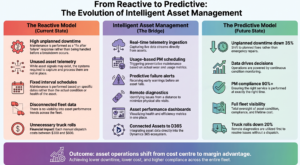
Four conditions keep asset-intensive operations locked in reactive mode.
Unplanned downtime rates stay high because the maintenance model is built around fixing equipment after it fails, not before. Every unplanned outage carries costs that a scheduled repair never would: emergency labor, expedited parts, lost production, and a technician arriving without diagnostic context.
Asset telemetry already exists in most operations. Temperature sensors, vibration monitors, pressure gauges, runtime counters: the data stream is running. What’s missing isn’t the signal. It’s the system that acts on it.
Maintenance schedules still run on fixed intervals. Fixed intervals can’t adapt to actual asset condition. Service too early and you waste labor and parts. Service too late and you risk failure. A fixed schedule guarantees one of those two outcomes every time.
Field service history and asset performance trends stay disconnected across the fleet. Without that correlation, nobody can see which assets are degrading faster than expected, which maintenance patterns are actually working, or where the next failure is most likely to come from.
Six Predictive Maintenance Capabilities That Reduce Downtime and Maintenance Cost
Modern field service management platforms address these four conditions through six interconnected capabilities. Together they shift maintenance from a fixed calendar to a live read of actual asset condition.
Real-time telemetry ingestion for continuous condition monitoring
Cloud IoT platform integration ingests real-time telemetry directly from equipment in the field. Temperature, vibration, pressure, runtime hours: whatever the asset reports becomes a continuous data stream rather than a note taken during a quarterly inspection. The asset is always talking. Now someone’s listening.
Preventive Maintenance scheduling that reflects actual asset condition
Usage-based Preventive Maintenance scheduling replaces fixed-interval calendars. Assets get serviced based on how hard they’re actually working, not on a date set months in advance. When maintenance is tied to actual asset condition rather than a fixed date, over-servicing and under-servicing both reduce. Labor goes where it’s needed. Parts aren’t replaced before their time.
Predictive alerts that flag failures before they happen
Anomaly detection models identify developing faults before they become failures. A bearing that starts vibrating outside its normal range gets flagged while it’s still a planned fix, not an emergency one. The difference in cost between those two outcomes is significant. The difference in disruption is larger.
Remote diagnostics that eliminate unnecessary truck rolls
Not every alert requires a dispatch. Remote diagnostics capability lets technicians assess many issues without a site visit. When a truck roll isn’t needed, the operation saves between $300 and $600 per avoided dispatch, and the technician’s time goes where it’s actually needed.
Asset performance dashboards that surface condition, compliance, and lifetime cost
Asset performance dashboards give operations leaders a clear view of every asset in the fleet: current condition, compliance status, and total lifetime cost. Decisions about repair, replace, or extend now have data behind them. Not guesswork.
Asset connectivity that links IoT signals directly to work orders
The asset connectivity module links IoT data to field service management work orders automatically. When an anomaly is detected, a work order generates without a manual handoff. The gap between signal and action closes completely. No email. No phone call. No delay.
Catch a Fault Before It Becomes a Failure
Under a reactive model, a developing equipment fault goes unnoticed until the next scheduled inspection or until the asset fails entirely. Either way, the outcome is the same: unplanned downtime, emergency dispatch, production loss, and a repair that’s always more expensive than it needed to be.
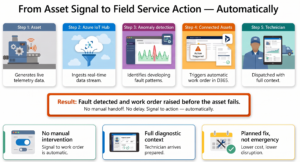
With predictive maintenance in place, the same fault is detected the moment telemetry moves outside its normal range. A work order generates automatically. A technician arrives with full diagnostic context before the asset fails. The fix happens on a planned timeline, not an emergency one.
That shift, applied across an entire fleet, changes the economics of maintenance. Organizations deploying these capabilities have seen Preventive Maintenance compliance reach 90% or higher, unplanned downtime drop by 35%, and unnecessary truck rolls reduce by 20% in the first year*.
How Microsoft Dynamics 365 Field Service Powers Predictive Maintenance
Microsoft Dynamics 365 Field Service provides the technology foundation that makes this shift possible. Its Connected Assets module links IoT sensor data directly to work orders, eliminating the manual handoff between signal detection and field dispatch. Azure IoT Hub ingests real-time telemetry streams from connected equipment across the fleet. Anomaly detection models built into the platform identify developing faults before they become failures. Usage-based Preventive Maintenance scheduling replaces fixed-interval calendars with condition-driven service triggers. Remote diagnostics capability allows technicians to assess and resolve many issues without a site visit. Together these capabilities create a closed loop: from asset signal to work order to resolution, automatically and without delay.
Your Assets Are Already Sending Signals. Is Anyone Listening?
The data your assets are generating right now contains the patterns needed to prevent your next unplanned failure. The question isn’t whether the signals exist. It’s whether your operation has the capability to act on them.
OwlSure’s Field Service practice works with asset-intensive operations to build exactly that capability, from IoT integration to predictive alerting to real-time work order generation.
Contact us for a free consultation.