

Executive summary
Many enterprises have modernized their data foundations but still struggle to turn that readiness into scalable AI outcomes. The missing link is often not more infrastructure, but an AI enablement layer that connects governed data to production ML and AI in a reusable, secure, and operational way. This layer helps standardize business context, create reusable AI-ready assets, extend governance into AI workflows, and support ongoing observability and control. Without it, AI efforts stay fragmented and difficult to scale. In this article we explore how, with it, enterprises can move from isolated pilots to a repeatable AI capability built on trusted data, shared semantics, and production-grade operating discipline.
Strong data foundations don’t result in AI outcomes on their own
We have seen organizations across the last two decades modernizing their data estates. They have moved to platforms, built warehouses, lakehouses, improved governance and built scalable ways to manage and serve data across their business.
However, in spite of all these efforts, most of these organizations still struggle to turn these investments into reliable and effective AI outcomes. ML initiatives often remain too dependent on project-specific engineering. AI projects show promise, but slow down when it needs trusted enterprise context, secure retrieval or production controls. BI, ML and AI often operate against common underlying data, but with different definitions, different logic and governance pathways. This leads to too many reinventions, with redundancies and lot of effort to move from pilots to scale.
There lies this gap in enterprises from having a modern data foundation and then having an enterprise AI capability.
What they are missing is not more infrastructure or services at in their foundation, or AI stack at the top. But it’s the lack of a layer in between: a set of shared capabilities that connects trusted data foundations, to production ready ML and AI systems in a consistent, governed and reusable way.
Why Data Readiness is not the same as AI readiness
Modern data foundations can make data easier to organize and move. They improve access, scale, integration, governance and efficiency, further the conditions for effective AI. However, this is not enough for making AI operational.
Because AI systems need more than access to data. It requires a lot more- business context, reusable logic, governed pathways into production, and mechanisms for ongoing evaluation and control.
A well-managed data platform can consolidate source data. But it does not automatically create a shared understanding of business meaning across reports, dashboards, models and AI applications. It cannot guarantee that the same business entity, KPI or decision signal, is defined consistently across reporting, training, inference and retrieval, or ensure that features are reusable across models. And it cannot make AI outcomes reliable, simply because enterprise data exists in its environment.
This is where we many AI programs lose momentum. The path for organizations from data foundation to scalable AI is fragmented. One team builds model features inside notebooks. Another defines KPIs in BI tools. A third creates retrieval logic for a AI application. A fourth could be asked to review risk and governance after the use case is already assembled. Each team solves a real problem, but through a different lens. Over time, this can risk the enterprise accumulating AI activities without establishing a repeatable AI capability at the enterprise level.
That is the problem the AI enablement layer can solve.
What is the AI enablement layer?
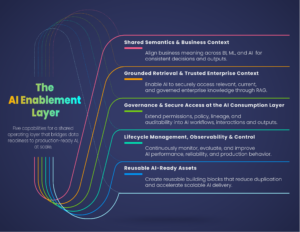
The AI enablement layer can be thought of as a shared operating layer between your data foundation and the AI-driven solutions built on top. At its core, it is the enterprise capability that makes data usable for AI, at scale, in production.
It does this by creating a common path from governed data to AI consumption. Translating data readiness into AI readiness by standardizing business context, packaging reusable assets, preserving governance and access controls, with supporting lifecycle management across ML and AI systems.
For enterprises, it can help answer a set of questions that they eventually would face:
- How does common business meanings flow into BI, ML and AI solutions?
- Do teams reuse features, logic, and context instead of rebuilding them, and how?
- Does permissions and governance carry through into models and AI interactions?
- How do we ensure that AI systems stay observable, reliable and manageable over time?
When these questions can be answered through shared enterprise capabilities rather than isolated project initiatives, AI will become easier to scale.
What this layer must do
A reliable AI enablement layer must support both ML and AI projects, even though they do not require the exact same things.
ML depends on well-defined features, training, inference consistency, deployment discipline and performance monitoring. AI needs grounded retrieval, role-based access to enterprise knowledge, orchestration, evaluation, output controls, etc. The common need is a governed, reusable operating layer that connects enterprise data and business context to AI outcomes in production.
That typically requires five capabilities:
- Shared semantics and business context
This is an important challenge that enterprises need to focus more on. AI systems in addition to all the high-quality data, also requires the right meaning of that data. If different team define the same customer state, risk indicator, metric or business event differently, then it will result in inconsistencies everywhere: in dashboards, model outputs, and AI or Agentic AI responses.
Scalable AI architecture needs a shared semantic foundation that defines core business entities, relationships, metrics, policies and context in a reusable way. This can allow BI, ML and AI agents to operate from the same business truth rather than from parallel interpretations of it.
For ML, it can improve feature alignment and reduces logic duplication. For AI, it can improve grounding because retrieval can be informed by business structure and meaning.
This is one reason the semantic layer should no longer be treated as only a reporting construct. In a mature enterprise architecture, it needs to become part of the AI operating model. - Grounded retrieval and trusted enterprise context for AI
For GenAI and agentic systems to become enterprise-ready, simply connecting them to internal documents is not enough. To be useful in production, they need access to trusted, current, and the right business context.
One of the most important enablement patterns is retrieval-augmented generation (RAG). A RAG solution combines enterprise data retrieval with generative models to produce context-aware, grounded outputs. It addresses a key gap in scaling AI by enabling models to securely access governed, up-to-date enterprise knowledge, especially enterprise data embedded in documents, PDFs, emails, and internal systems, rather than relying only on static training.
By retrieving relevant content from these sources at runtime and injecting it into prompts, RAG can ensure improved accuracy, trust, and compliance while minimizing hallucinations. This creates a reusable, secure layer that standardizes business context, extends governance to unstructured data, and supports scalable, production-grade AI applications.
A strong AI enablement layer makes this grounding possible by ensuring AI systems can retrieve the right context from the right sources, for relevant users, under proper controls. - Governance and Secure access at the AI consumption layer
Governed data does not lead to governed AI.
With all new initiatives across the enterprise, AI creates a new consumption layer. Models infer patterns, AI systems synthesize information across sources. Prompts, retrieved context, outputs and feedback all become part of the control surface. This means governance must be thought through an established to extend beyond the data platform, and into the way AI systems access, combine and expose enterprise information.
A strong AI enablement layer preserves access controls, policy rules, lineage and auditability as data moves into model pipelines and AI or Agentic workflows. It needs to ensure appropriate handling of sensitive information, traceability of outputs to sources and logic, and the right approval and review mechanisms for higher-risk use cases.
Trust in AI and agentic outputs cannot be created by a good model alone. It comes from controlled context, grounded responses, permission aware retrieval and the ability to explain where an answer came from. - Lifecycle management, observability and control
A new AI assistant or agentic workflow at your enterprise does not become reliable just because it has been deployed once.
AI solutions in production need ongoing oversight. For ML that means monitoring performance, drift, feature behavior, retraining triggers, etc. For AI, it means monitoring retrieval relevance, output quality, hallucination risk, escalation behaviour, task success in real usage, and a lot more.
With an operational AI enablement layer, it can provide the mechanisms to evaluate, monitor and improve AI systems over time. This makes AI observable as a product, and not just a technical artifact.
This distinction matter. Because enterprises do not scale AI by launching more pilots. They do so by building a repeatable system for managing AI in production. - Reusable AI-ready assets
While organizations aspire to scale AI, yet project teams often recreate foundational capabilities per use case, driving inefficiencies and duplication.
A more scalable model is to create reusable assets that bridge data and AI consumption. That can include curated feature definitions for ML, in addition to governed retrieval indexes, embeddings, prompt context patterns, evaluation datasets, model ready data products, etc. The important shift is from project-specific assembly to shared enablement.
This way, the enterprise creates standardized and reusable components with clear ownership, lineage, quality checks and versioning. This leads to reduced rework and redundancy, improved trust, and shortens the time required to move from idea to production.
What happens now when you don’t have this layer?
When the AI enablement layer is missing, the symptoms tend to look different on the surface but stem from the same root issue.
Teams duplicate feature logic. Business definitions drift across tools and workflows. AI and agentic systems retrieve content that looks relevant, but is not authoritative. Monitoring is inconsistent. Security and governance reviews happen too late. Outputs become harder to trust because they are difficult to explain, reproduce or trace.
In such an environment, that you may currently be having, AI delivery becomes slow and fragile. Every new use case feels like a custom build. Progress depends on a few experts stitching together data, models, prompts, tools, agents, and workflows manually. Your organization may have many AI initiatives, but it does not yet have an AI operating model.
That is why the AI enablement layer matters. It addresses the structural reasons AI struggles to scale in an enterprise, not just the issues that crop up inside individual projects.
How data leaders can approach building the AI enablement layer
For organizations that have a relatively modern data estate and taken the step into AI initiatives, they do not need to rebuild their architecture from scratch. They need to identify weaknesses in the connection between data foundations and AI delivery, and strengthen it in a focused way.
A useful staring point is to examine four things:
- First, ask, where does business meaning exist today? Is it reusable across analytics and AI, or scattered across SQL, dashboards, model code, and prompts?
- Second, identify which AI inputs are being rebuilt repeatedly? This could be features, retrieval pipelines, evaluation logic, contextual definitions, etc.
- Third, track how well does your governance and access controls carry through into AI initiatives and workflows? Are permissions, lineage, policy enforcements preserved when data moves into models or agentic systems?
- Fourth, see if AI is monitored in production. Can your organization see not just whether a model is deployed, but whether it is reliable, grounded and delivering the intended outcome?
The answers to these questions can reveal where the enablement gaps are. For many enterprises, the priority is shared semantics. For ones more mature in their AI adoption journey, it could be strengthening AI grounding and governance or reusable ML assets, etc. Whatever your situation, the objective is the same: build shared enterprise capabilities instead of solving for AI-driven use case from scratch.
The next phase of effective enterprise AI will be defined by those who can modernize their data foundation, strategically approach AI investments and operationalize AI repeatedly, safely, and with less reinvention.
As a data leader, get started on your Data and AI journey with an Enterprise Data Strategy Assessment led by experts at OwlSure. Click here to learn how OwlSure helps enterprises modernize their data foundations, and scale their AI initiatives.
Authors:
Renji Krishnan, Senior Product Marketing Manager