

You already have an intranet. Your employees just don’t use it.
- Your policies are in SharePoint.
- Your documents are in SharePoint.
- Your announcements are in SharePoint.
- Your organizational knowledge is in SharePoint.
So why are employees still asking, “Where can I find that?”
For many organizations, SharePoint is already the intranet. It provides document management, collaboration, permissions, security, and governance, yet employees still find themselves searching Teams, scrolling through emails, asking colleagues, raising IT or HR tickets, or sometimes simply giving up when they can’t find the information they need.
SharePoint can store, manage, and secure information, but that doesn’t necessarily mean that every employee can find, understand, or act on that information easily and on time. The gap is between what SharePoint can do and what employees now expect an intranet to do for them.
Employees today are used to digital experiences that are intuitive, personalized, searchable, mobile-friendly, and increasingly conversational. They expect technology to help them get the right information with less effort, without needing to navigate through layers of content to find it.
The technology (SharePoint intranet) hasn’t necessarily become inadequate. The expectations around it have changed. And when those expectations aren’t met, the intranet starts feeling less like a workplace tool and more like a place employees must work around.
Microsoft’s 2023 Work Trend Index found that 62% of survey respondents said they struggled with spending too much time searching for information during their workday. Microsoft described this broader accumulation of data, emails, chats, and information as “digital debt.”
McKinsey has also estimated that knowledge workers spend roughly one-fifth of their time searching for and gathering information.
The issue isn’t necessarily that employees don’t have access to information. It’s that they have too much information and not enough guidance and clarity.
The content isn’t necessarily missing. The challenge is making it easy to find.
Your SharePoint documents and information may be systematically organized across sites, folders, and libraries, but that doesn’t necessarily make them easy for employees to find. The way information is structured and categorized may not align with how employees search for it, making it difficult for SharePoint’s search to surface the right documents and resources. Even when the information exists, employees may have to try multiple search terms, navigate through irrelevant results, or browse different locations before finding what they need. The challenge isn’t how well information is stored, but how effective the search experience is.
A modern intranet bridges this gap with smarter, more comprehensive search and discovery capabilities that help employees find the right information quickly and effortlessly.
Content is published. Relevance is missing.
A company-wide homepage may show dozens of announcements. An employee doesn’t need every announcement; they need announcements relevant to their role, department, location, or responsibilities. A quick search function should also surface the right information relevant to the user.
Search expectations have evolved. Has your intranet search kept up?
Today’s employees are accustomed to finding information quickly through intuitive search experiences, personalized recommendations, and increasingly, AI-powered tools. They expect to search using natural language, find relevant results without navigating multiple pages and folders, and get answers without having to know exactly where information is stored. This shift is particularly relevant for Millennials and Gen Z, whose expectations of workplace technology are influenced by the digital experiences they use every day.
Deloitte‘s 2026 India Gen Z and Millennial Survey found that 93% of Gen Z and 95% of Millennials in India use AI in their day-to-day work, while more than 90% of both groups report a positive impact from AI on their professional and personal lives.
This growing familiarity with AI-powered tools highlights the need for workplace search to move beyond basic keyword matching. Employees increasingly need search experiences that understand intent, surface relevant information, connect related knowledge, and make answers easier to access.
For organizations that already use SharePoint as their intranet, the opportunity isn’t to start over with another platform. It’s to modernize how employees search, discover, and access the information already available within their existing SharePoint environment.
You already have:
- Years of organizational content
- Established permissions
- Security controls
- Governance processes
- Microsoft 365 integrations
- Content owners
- IT administrators
- Employee familiarity with Microsoft tools
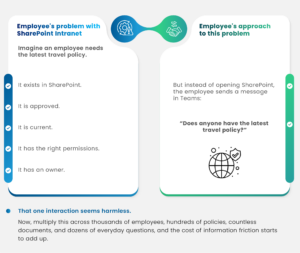
Replacing the platform means revisiting many of these elements. More importantly, changing the platform doesn’t automatically change the experience. If employees weren’t able to find the travel policy before, moving the same travel policy to another platform doesn’t guarantee they will find it now. If knowledge was fragmented before, moving fragmented knowledge somewhere else doesn’t make it coherent. If content wasn’t relevant before, a new homepage doesn’t automatically make it personalized.
A new platform changes where information lives. Modernization changes how employees experience it.
What should a modern SharePoint intranet experience look like?
The answer isn’t another repository. It’s an employee experience, built around how people actually work, putting their tasks, context, and intent at the center.
With a modern UX layer like OwlSure’s Modern Intranet built on top of your existing SharePoint intranet, organizations can transform how employees discover information, interact with content, and get work done, while maximizing the value of their existing SharePoint investment.
Personalized content for every employee, not the same homepage for everyone, based on role, department, location, and language, so employees spend less time filtering through information that doesn’t apply to them.
Search that understands intent. AI-assisted search and discovery helps employees move beyond keywords and find relevant documents, answers, knowledge, people, or resources faster.
Knowledge that is easier to discover by bringing scattered organizational knowledge into an experience where employees can navigate naturally, helping them discover not just documents, but the relationships between policies, processes, people, resources, and business knowledge.
Mobile access built for today’s workforce, so employees can reach the platform on the go. It gives employees access to relevant information and services across locations, devices, shifts, and working environments.
Employees can participate, not just read announcements. It creates opportunities for conversations, communities, recognition, employee-generated content, feedback, and interaction.
The goal is to make the intranet a place employees participate in, not simply a place they occasionally visit.
Give business teams more control, without needing IT involvement for every content change. Enable business teams to create, manage, update, and publish content while maintaining the required governance and controls.
A modernized employee experience within the Microsoft 365 environment. Existing permissions, security, retention, compliance, and governance practices can continue to guide how content is managed while employees get a more intuitive way to access and use it.
Modernize the experience. Keep SharePoint.