

Executive summary
Business value increasingly depends on how quickly organizations can move from business events to the right decisions. While traditional batch-based data architectures remain essential for historical reporting, regulatory and planning use cases, they are too slow for real-time use cases and decisions that need to happen while business conditions change.
As organizations scale analytics, AI and automation, data leaders need to reduce the gap between business events and business action. Real-time intelligence enables organizations to capture events as they occur, enrich them with trusted context, apply analytics or AI and trigger timely decisions with governance and control. Explore the capabilities required to enable real-time intelligence and how data leaders can build a practical roadmap towards real-time decisioning.
In this article
- Why Batch processing is no longer enough
- The shift from Reporting Latency to Decision Latency
- What Real-Time Intelligence means in practice
- Five capabilities for real-time intelligence and decisioning
- Building a Roadmap towards real-time intelligence
- Governance and Trust at the point of decision
- Actions data leaders can take next
Why Batch processing is no longer enough
Batch processing has served enterprises well because many analytical workloads do not require immediate action. Leaders need month-end reports, compliance extracts, portfolio analysis, business performance reviews, financial reconciliation and historical trend reporting.
However, an emerging challenge is that modern business operations increasingly depend on decisions that cannot wait for the next scheduled refresh. A bank may need to detect abnormal account behaviour within seconds. An insurer may need to identify claim leakage before payment decisions are made. A healthcare payer may need timely visibility into member interactions, service delays, etc. In these moments, delayed data can create financial risk, operational inefficiency, poor customer experience, or missed intervention opportunities.
This becomes even more important as organizations adopt AI. AI models, decision engines and intelligent workflows depend not only on clean and governed data, but also on timely context. A risk model using stale data may miss a rapidly changing pattern. A customer service AI assistant that lacks the latest interaction history may provide incomplete guidance. A claims workflow that receives updated information too late may still require manual rework. It’s not that batch processing is obsolete. It is that batch should no longer be the only operating rhythm of enterprise intelligence.
Data leaders need a hybrid approach: batch for historical and structured analytical workloads and real-time or near-real-time pipelines for use cases where responsiveness directly affects outcomes.
The shift from Reporting Latency to Decision Latency
Many organizations still think about data modernization in terms of faster reporting. But the more strategic question is: how quickly can the business make a better decision? This is the shift needed from reporting latency to decision latency.
Reporting latency is the time it takes for data to appear in a dashboard or analytical system. Decision latency is the time between a business event occurring and the organization being able to respond effectively.
In banking, the event may be a transaction attempt, in insurance, it may be a first notice of loss, in healthcare, it may be an appointment cancellation. Real-time intelligence reduces the gap between these events and the next best action. That action may be an alert, recommendation, workflow trigger, model score, case escalation, personalized communication or automated decision.
This is what makes real-time intelligence different from simply refreshing dashboards more frequently. The objective is not just to see faster. It is to act sooner with better context.
What Real-Time Intelligence means in practice
Real-time intelligence is the ability to capture business events as they happen, enrich them with relevant context, analyze them through rules, analytics, AI and trigger an appropriate response.
The required speed depends on the use case. A fraud authorization decision may need to happen in milliseconds or seconds, but a healthcare operations dashboard may deliver value with near-real-time refreshes across the day. A risk monitoring process may need continuous event feeds but not instant automation. This distinction matters because real-time architecture should be designed around business urgency, not technology ambition. Making every pipeline ultra-low latency can increase cost and complexity without delivering proportional value. On the other hand, treating high-impact operational decisions like traditional reporting workloads can prevent analytics and AI from being useful when they matter most.
The practical goal is to classify use cases by required latency, business impact, regulatory sensitivity, data availability and actionability. This helps determine whether a workload needs streaming, micro-batch, change data capture, API-based integration, event-driven workflows or traditional batch processing.
Real-time intelligence creates value by helping organizations respond while action is still possible. The broader value is the ability to connect data, context, decisions and outcomes in a continuous flow. This is what separates faster reporting from real-time intelligence. Faster reporting helps leaders see what is happening sooner. Real-time intelligence helps the business act on what is happening now.
Five capabilities for real-time intelligence and decisioning
Building real-time intelligence requires more than streaming technology. It requires an enterprise capability that connects data engineering, architecture, analytics, AI, governance and business operations. A practical approach to real-time intelligence rests on five key capabilities:
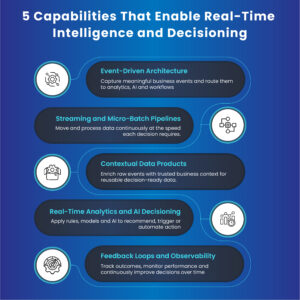
- Event-Driven Architectures
To start with, a foundation needs to be established with the ability to recognize and respond to business events. An event represents a meaningful change in state: a payment initiated, a claim created, a policy updated, a care request submitted, a member interaction completed, or a risk threshold crossed.
In traditional data flows, systems often exchange information through scheduled jobs or tightly coupled integrations. This can create delays, duplication and dependency across applications. Event-driven architectures can allow source systems to publish events that multiple downstream consumers can use independently.
For example, a transaction event in banking may be consumed by fraud detection, customer notification, compliance monitoring and operational analytics. A claims event in insurance may support triage, reserving, document processing, litigation risk detection and adjuster workflow prioritization.
The advantage is flexibility. Producers and consumers are decoupled, allowing new analytics and AI use cases to be added without rebuilding every integration.
For data leaders, the key design questions are: which events matter, what business meaning do they carry, which systems need to consume them and what decisions should they influence? - Streaming and Micro-Batch Pipelines
Once critical events are identified, organizations need pipelines that can move and process data at the right speed.
Streaming pipelines process data continuously as events occur. Micro-batch pipelines process small groups of data at frequent intervals. Change data capture (CDC) can identify updates in operational systems and make them available downstream with lower latency. APIs can also support real-time data access where event streams are not practical. The best approach depends on the use case- An insurer’s claims analytics process may use micro-batch updates every few minutes. A healthcare payer’s member engagement system may combine event feeds, API calls and periodic enrichment from master data.
Reliable pipelines should also handle the realities of enterprise data: schema changes, late-arriving records, duplicate events, failed messages, data quality issues, replay requirements and monitoring. Without necessary controls, real-time systems may move quickly but create or exacerbate existing issues with data, leading to poor trust downstream.
A mature approach should include data validation, error handling, observability, lineage and clear ownership. Real-time pipelines need to be treated as production-grade business infrastructure, not experimental data engineering assets. - Contextual Data Products
Raw events rarely provide enough information for high-quality decisions. For example, a banking transaction event may say that money moved, but a fraud model may also need customer history, device profile, account behaviour, merchant patterns, location signals and previous alerts.
This is why real-time intelligence needs contextual data products. These are reusable, governed, business-ready data assets built around important entities and decision areas: customer, account, claim, policy, provider, patient, member, transaction, episode of care, or risk profile.
Instead of building one-off pipelines for every use case, organizations can create shared data products that serve dashboards, AI models, decision engines, operational workflows and digital applications.
This also improves AI readiness. Predictive models, recommendation systems, GenAI assistants and decisioning workflows perform better when they have access to trusted, current and business-defined context.
For data leaders, this means real-time modernization should not focus only on the speed of ingestion. It should also focus on how data is modelled, enriched, governed and made reusable across consumption patterns. - Real-Time Analytics and AI-Driven Decisioning
The value of real-time data comes from its ability to influence action.
Real-time analytics can detect patterns, calculate metrics, monitor thresholds, identify anomalies and generate alerts. Decisioning systems go further by determining what should happen next based on rules, models, business policies and context. For example, in insurance, it may mean routing a claim to a specialized adjuster, triggering fraud review or recommending next-best action.
These decisions may be human-assisted or automated. In many enterprise environments, the most practical starting point is decision support: surfacing the right insight to the right person within the right workflow. Over time, repeatable and lower-risk decisions can be automated with appropriate controls.
AI expands these capabilities by detecting complex patterns, ranking priorities, generating recommendations, summarizing context and supporting intelligent workflow orchestration. But AI-driven decisioning must be explainable, monitored and aligned with business policy, especially in regulated sectors.
Real-time intelligence should therefore combine speed with governance. Faster decisions are valuable only when they are trusted, auditable and operationally usable. - Feedback Loops and Observability
Real-time decisioning becomes more powerful when outcomes are captured and used to improve future performance.
If a fraud alert is generated, was it confirmed or dismissed? If a claim was routed for review, did it reduce leakage or cycle time? If a care management intervention was triggered, did it improve engagement or outcomes? If an AI recommendation was shown to an employee, was it accepted, modified or ignored?
These feedback signals help improve rules, retrain models, refine thresholds, evaluate AI outputs and measure business impact.
Another equally important aspect is observability. Data and AI teams need visibility into pipeline health, latency, data quality, event volumes, model performance, decision accuracy, exception rates, etc. Without proper observability, real-time systems can become difficult to troubleshoot and hard to trust.
For enterprise leaders, feedback loops turn real-time intelligence from a one-way data flow into a learning system. This is especially valuable for AI initiatives, where continuous monitoring and improvement are essential for production-scale adoption.
Building a Roadmap towards Real-time intelligence
For any organization, the path to real-time intelligence should be use-case led. A good starting point is to identify decisions where latency creates measurable business impact. Som examples across insurance, finance and healthcare can include- fraud detection, claims triage, underwriting risk signals, payment monitoring, member engagement, patient access, care management, financial anomaly detection, etc.
Once these use cases are identified, data leaders can assess them through five questions:
- What business event should trigger action?
- What data and context are required to make the decision?
- How quickly does the decision need to happen?
- Who or what takes the action: a person, workflow, model, or automated system?
- How will outcomes be captured and used for improvement?
This helps organizations avoid two common traps: modernizing pipelines without a clear business decision in mind or applying real-time technology where batch processing is sufficient.
A practical roadmap may begin with one or two high-value use cases, establish reusable event and data product patterns, then expand across domains. For example, an insurer may start with claims triage, then extend similar patterns to underwriting, fraud and customer service. A credit union may begin with transaction monitoring, then expand to credit risk, collections and customer engagement. The priority should be on developing scalable patterns and not isolated proofs of concept.
Governance and Trust at the Point of Decision
As data moves faster and more decisions are supported by AI, governance must operate closer to the point of consumption.
Real-time systems need controls for access, consent, privacy, lineage, data quality, model monitoring, audit trails and policy enforcement. This is especially important in banking, insurance and healthcare, where decisions may affect customers, patients, members, providers, regulators and internal risk teams.
Governance should not be treated as a separate downstream activity. It must be embedded into event design, pipeline architecture, data products, decisioning logic and AI workflows. The goal is not to slow innovation. It is to make real-time intelligence safe enough to scale.
Actions Data Leaders can take next
The move from batch to continuous insight should begin with the decisions that matter most.
Data leaders should map where delayed data limits responsiveness, increases risk, creates manual effort, or prevents AI from being effective in production. From there, they can prioritize the events, pipelines, contextual data products, decisioning workflows and feedback loops required to support real-time operations.
Batch processing will continue to remain essential for many enterprise workloads. But organizations that rely only on batch will struggle to support those use cases that requires the next generation of AI-enabled decisioning, digital operations and adaptive customer experiences. And the future of enterprise intelligence will be defined by how effectively organizations can sense business events, apply trusted context, decide with confidence and learn from outcomes.
As a data leader, get started on your Data and AI journey with experts from OwlSure. Click here to learn how OwlSure helps enterprises modernize their data and AI foundations for the future of enterprise and real-time intelligence.
Author:
Renji Krishnan, Senior Product Marketing Manager