

Executive Summary
As organizations scale analytics and AI initiatives, there is an emerging challenge in enabling AI, analytics and business users to access trusted data across increasingly complex ecosystems. Data now resides across business units, cloud platforms, applications, partners, suppliers and external providers, making interoperability a strategic business capability rather than a technical integration exercise. We explore how organizations can securely share, discover and consume trusted data across enterprise boundaries to accelerate data-driven innovation, improve decision-making and create stronger foundations for AI.
In this article
- Why interoperability is becoming a strategic business capability
- The shifts from enterprise data platforms to connected data ecosystems
- Building interoperable data ecosystems
- The benefits
- How can data leaders get started?
Why Interoperability is becoming a Strategic Business Capability
For years, organizations focused on integrating applications and consolidating data into centralized platforms. While these efforts improve reporting and analytics, business value increasingly depends on data that exists beyond enterprise boundaries.
Customer experiences, supply chains, risk decisions, operational processes and ecosystem partnerships all rely on information that spans business units, platforms, partners, suppliers and external providers. As a result, the ability to securely share, access and interpret data across organizational boundaries has become a strategic business capability rather than simply a technical integration challenge.
AI is accelerating this shift. AI models, copilots, and intelligent agents require access to trusted context from across the ecosystem to generate reliable outcomes. Many organizations pursuing AI initiatives discover that the primary constraint is not model capability, it is data accessibility, trustworthiness and interoperability.
Generative/Agentic AI amplify this challenge. AI systems increasingly need to access and act on information across multiple domains, applications and organizations. Whether supporting supply chain decisions, customer service, fraud detection, risk management or operational planning, AI delivers greater value when it can draw from a broader ecosystem of trusted data. As organizations move from AI experimentation to production-scale copilots and agents, interoperability is increasingly extending beyond data exchanges to include standardized interactions between AI systems, enterprise applications and external services.
Without interoperability, organizations risk creating limited analytics and AI initiatives that deliver localized value but fail to scale across the enterprise. With it, they create the foundation for “ecosystem intelligence” that spans business functions, platforms and partners.
The Shifts from Enterprise Data Platforms to Connected Data Ecosystems
As organizations expand digital ecosystems, analytics programs and AI initiatives, they are rethinking how data is shared and consumed. We see several important shifts that are reshaping interoperability strategies:
- From data movement to data access – Rather than continuously copying data across platforms, organizations are increasingly enabling governed access to distributed data wherever it resides. This reduces duplication, improves consistency and accelerates access to information. For example, insurers need claims, policy, customer and third-party risk data to support underwriting or fraud investigations. Instead of replicating data across multiple platforms, governed access enables users to securely access trusted information from source systems while maintaining appropriate controls.
- From integration projects to data products – Instead of building custom integrations for every consumer, organizations are packaging trusted datasets as reusable data products with defined ownership, quality standards, metadata and service expectations. Healthcare organizations, for example, may expose a Patient 360 or Provider 360 data product that can be reused across care management, member engagement, analytics and AI initiatives. This reduces redundant integration effort while improving consistency and trust.
- From centralized control to federated collaboration – Business domains are increasingly managing and sharing their own data while adhering to enterprise-wide governance standards, balancing agility with consistency. In a banking environment, customer, lending, payments and risk teams often possess deep domain expertise and unique data requirements. Federated ownership allows these teams to manage and share their data while operating within a common governance framework, improving responsiveness without sacrificing control.
- From enterprise intelligence to ecosystem intelligence – Organizations are combining internal and external data sources to create richer business context, uncover new opportunities and improve decision-making across value chains and partner networks. Consider a health insurer combining claims, provider, pharmacy and social determinants of health data to improve care management outcomes, or a commercial insurer enriching internal policy data with external weather, geospatial and risk intelligence to improve underwriting decisions. The greatest value increasingly comes not from any single dataset, but from the ability to connect insights across the broader ecosystem.
These shifts show that the value of data increasingly depends on how effectively it can be shared, contextualized and governed across ecosystems.
Building Interoperable Data Ecosystems
Across our modernization initiatives across clients, one pattern consistently emerges: organizations that generate the greatest value from analytics and AI are those that can connect, contextualize, govern and share data effectively across ecosystems.
Building this capability requires more than technology. It requires architectural, operational and governance practices that enable interoperability to scale:
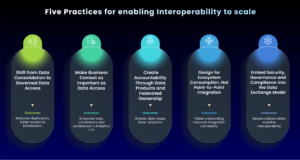
- Shift from Data Consolidation to Governed Data Access
Many organizations still approach interoperability by moving and replicating data into centralized repositories. While this may solve immediate integration challenges, it often creates new problems around duplication, latency, governance, and cost.
Leading organizations increasingly focus on governed access rather than unrestricted movement. Data fabric architectures, virtualization technologies and federated access models allow users, applications and AI systems to securely discover and access data where it resides without creating unnecessary copies.
This approach becomes particularly valuable as data volumes grow, cloud environments multiply and organizations expand their ecosystem partnerships. The goal is not to centralize all data, but to make trusted data accessible wherever it creates value.
- Make Business Context asimportant as Data Access
Many interoperability initiatives succeed technically but fail operationally because different teams interpret the same data differently.
A customer, supplier, product, revenue metric or risk score may have different definitions across business units and partner organizations. AI only amplifies these inconsistencies, often producing conflicting insights and reducing trust in outcomes.
Successful organizations invest in shared business semantics, metadata, lineage, and data product documentation, to make data understandable and trustworthy.
As AI adoption grows, business context increasingly becomes as important as the data itself. Metadata and semantic layers provide the common language that allows everyone to interpret information consistently across domains.
- Create Accountability Through Data Products and Federated Ownership
One of the biggest barriers to scalable data sharing is unclear ownership. Shared datasets often become everyone’s responsibility and no one’s responsibility at the same time.
Leading organizations address this by treating data as a product with clearly defined owners, quality expectations, service levels, usage policies, and documentation. At the same time, they adopt federated operating models that allow business domains to retain accountability for the data they understand best.
This combination enables interoperability to scale without creating bottlenecks within a centralized data team. It also improves trust because consumers know who owns the data, how it is maintained, and what level of quality they can expect.
As organizations expand ecosystem collaboration, federated ownership becomes increasingly important for balancing local accountability with enterprise-wide governance.
- Design for Ecosystem Consumption, Not Point-to-Point Integration
Many organizations still manage data sharing through hundreds of custom interfaces built for specific consumers and use cases. While effective initially, this approach becomes increasingly difficult to govern, maintain, and scale.
Organizations that excel at interoperability design data assets for broad consumption from the outset. APIs, event-driven architectures, open standards, common contracts, and reusable access patterns allow new consumers, whether internal teams, partners, applications, or AI systems, to onboard more quickly without requiring extensive custom development.
As AI adoption grows, standards such as Model Context Protocol (MCP) are also helping establish consistent patterns for how AI assistants and agents access enterprise data, tools and services. While APIs remain foundational, organizations are increasingly evaluating how these standards can simplify AI-to-system interoperability, accelerate agent deployment and reduce the complexity of integrating intelligent applications into existing ecosystems.
The goal is creating a repeatable model for sharing trusted data across a growing ecosystem while reducing integration complexity and accelerating innovation.
- Embed Security, Governance and Compliance into the Exchange Model
A major challenge in data sharing is trust. As data moves across business units, cloud environments and partner networks, organizations need confidence that access policies, privacy requirements, usage restrictions and regulatory obligations remain intact.
Rather than treating governance as a separate control function, leading organizations increasingly embed security, compliance, lineage, consent management and policy enforcement directly into the data-sharing lifecycle. Metadata-driven controls and automated policy enforcement help ensure that data remains secure, compliant, and auditable regardless of where it is consumed. When trust is built into the exchange model, organizations can expand data sharing and AI adoption without proportionally increasing risk.
The Benefit of Interoperable ecosystems
Organizations that embrace interoperable data ecosystems gain benefits that extend far beyond integration efficiency. Trusted data becomes easier to discover, understand and consume. Teams spend less time searching for information and more time generating value from it. Data products are reused across initiatives rather than recreated repeatedly. Partner onboarding becomes faster and collaboration becomes more scalable.
More importantly, organizations gain the ability to combine internal and external data to create richer context for analytics and AI. This enables new forms of intelligence: from customer insights and operational optimization to supply chain visibility, risk management and ecosystem-wide decision-making. Additionally, AI systems become more effective because they operate with broader context, higher-quality information and stronger governance. The result is faster innovation, more informed decisions and greater business agility.
How can data leaders get started?
For many organizations, the first interoperability challenge exists within their own enterprise. Data-sharing friction often emerges between business units, platforms, domains and applications long before it extends to external ecosystems.
- Start by identifying where these barriers are limiting business outcomes.
- Prioritize high-value use cases where broader access to trusted data can accelerate decision-making, improve customer experiences or enhance AI effectiveness.
- Then establish the foundations one-by-one: governed data access, shared business semantics, data products, federated ownership, scalable sharing patterns and embedded governance.
We at OwlSure help organizations to modernize their data foundations and build strong data sharing and interoperability capabilities. Across industries including healthcare, insurance, banking, lending & leasing, we partner with clients to realize value from their data and enable better business outcomes. Click here, to get started on your Data and AI journey with experts from OwlSure.
Author:
Renji Krishnan, Senior Product Marketing Manager