
Experienced technicians with decades of diagnostic instinct and equipment knowledge are retiring faster than organizations can capture what they know. At the same time, the complexity of what technicians are expected to service is growing: expanding product portfolios, increasingly sophisticated assets, wider geographic coverage. The knowledge required to perform at a high level has never been greater. The systems for transferring that knowledge have not kept pace.
The result shows up in callbacks, SLA breaches, and customer satisfaction scores that operations leaders track closely and struggle to move.
Why the Field Technician Performance Gap Keeps Widening
Four conditions drive the gap in most field service organizations.
Knowledge concentration risk is the first. When a senior technician with 20 years of asset experience retires, that knowledge leaves with them. Without a system to capture it, that knowledge is lost. Most organizations do not have that system.
Skill gaps are widening across expanding product portfolios and increasingly complex equipment. Technicians at every level are being asked to service assets they have limited exposure to, with limited structured support.
Performance variance between top and bottom-quartile technicians is wide and measurable. The top quartile fixes jobs first time, meets SLAs consistently, and earns customer confidence. The bottom quartile generates callbacks, breaches SLAs, and costs the business in rework and churn. That variance has a direct, quantifiable cost.
Real-time decision support is unavailable in field conditions. When a technician hits an unfamiliar failure mode on-site, the options are recall, improvisation, or a call back to base — none of which are fast or reliable at scale.
How Field Service Management Technology Closes the Gap
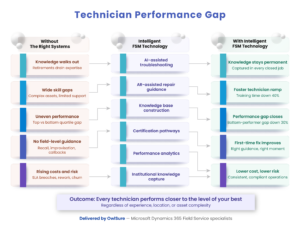
Modern field service management platforms address these four conditions through six interconnected capabilities that change how technicians work and how organizations capture and distribute knowledge.
AI assisted troubleshooting at the point of service
Copilot AI delivers real-time guided troubleshooting during a job, surfacing the most likely failure causes, recommended resolution steps, and relevant asset history. The system surfaces what the technician needs, at the moment they need it. Less experienced technicians make better decisions faster, and first-time fix rates improve across the board.
AR-assisted repair guidance for complex equipment
Beyond text-based guidance, augmented reality tools deliver visual, step-by-step repair procedures overlaid on the actual asset. On unfamiliar equipment, this reduces errors and compresses the time it takes newer technicians to work confidently. The technician sees what to do, not just reads what to do.
Knowledge base construction from real field experience
Structured knowledge capture workflows are embedded in the work order close process, turning every completed job into a searchable, reusable resolution record. Over time, this builds an operational knowledge base drawn from actual field experience. What your best technicians know becomes permanently available to every technician.
Learning and certification pathways linked to dispatch
Certification and learning progression integrate directly with work order assignment logic. Technicians are dispatched to jobs matched to their current skill level. Skill development connects to real operational outcomes, not classroom schedules. It happens inside the work, not outside it.
Analytics-driven coaching that targets the right technician at the right time
Technician performance dashboards segmented by skill, asset class, and geography show managers exactly where gaps exist and who needs support. Coaching becomes targeted rather than generalized. Over time, the performance floor across the team rises consistently.
Institutional knowledge that stays with the organization
When a senior technician retires, their knowledge does not have to leave with them. Embedded capture workflows, historical work order pattern analysis, and structured resolution data ensure that expertise accumulates in the system, not in any single person. The organization gets stronger with every job closed, not weaker with every retirement.
What Changes When the Right Systems Are in Place
A mid-tenure technician is dispatched to an unfamiliar asset class. Without support, the job depends on recall or a call back to base, runs long, and often closes incorrectly. A callback follows.
With the right platform in place, the technician arrives with full asset history. Copilot AI surfaces the most likely failure causes based on similar jobs. AR guidance walks through the repair procedure step by step. The job closes correctly, first time.
That outcome, repeated across hundreds of dispatches a month, is what moves the metrics. Organizations deploying these capabilities have seen the bottom-performer gap close by 30% and technician training time reduce by 40%*.
Ready to Build a More Consistent, Knowledge-Enabled Field Service Operation
OwlSure’s Field Service practice brings together functional expertise and deep Microsoft Dynamics 365 Field Service capability, built across the Power Platform and Azure, to design and deliver workforce enablement solutions that produce measurable results in the field.
The outcomes our clients work toward are specific. Faster technician ramp times. Higher first-time fix rates. A knowledge infrastructure that grows stronger with every job closed.
Your best technician cannot be everywhere. With the right systems in place, their knowledge can.
Contact us for a free consultation.
*Source: How AI can give field service technicians a boost