

Executive Summary
As MGAs scale, month-end close breaks down not because core systems fail, but because financial control doesn’t scale with operations. Stable platforms mask growing reconciliation effort, manual adjustments, and audit risk, turning close into investigation rather than validation.
Leading MGAs are not replacing core systems. They are strengthening the financial layer around them by establishing governed entry points into the general ledger transforming month-end close from investigation into confirmation, and enabling confident, sustainable growth.
Introduction
Most MGA finance leaders do not lose sleep over their core systems. They lose sleep over whether the numbers will hold up at close.
They ideally rely on long-standing, all-in-one systems that have supported underwriting and policy operations for years. They’re stable. They’re familiar. They’ve handled growth before. So, when month-end close starts to strain, the instinct isn’t to question the system — it’s to assume finance just needs to work harder. That assumption is usually wrong.
In FinOps terms, this is the moment where operational efficiency outpaces financial control. Without governed data flows into accounting, effort increases while confidence erodes, and month-end becomes a test of endurance rather than validation.
When Stability Masks a Growing Finance Risk
Suite systems are designed to process policies efficiently. They handle issuance, endorsements, and operational reporting well. What they are not designed to do is function as finance-grade systems of record. As MGAs scale, this distinction becomes increasingly important. The system may continue to “work,” but the financial friction around it grows quietly in the background.
Industry benchmarks show that finance teams at growing insurance intermediaries spend 30–50 percent of close effort reconciling and adjusting operational data before it can be trusted for reporting.
Operational stability creates a false sense of control. The platform performs exactly as designed, while finance quietly absorbs the cost of validating outcomes downstream.
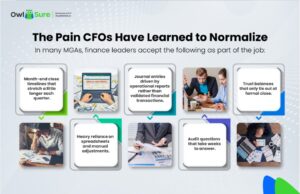
There is a common saying in finance, “If it reconciles eventually, it becomes acceptable.”
Over time, that mindset quietly resets expectations.
Individually, none of these issues feels catastrophic. Taken together, they point to a control gap rather than an efficiency problem, one that becomes harder to unwind the longer it is normalized.
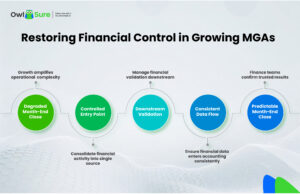
The following sections break down how growth changes the flow of financial data inside MGAs, and how leading finance teams apply FinOps discipline to restore control before close and scale begin to suffer.
- Why Month-End Close Degrades with Growth
Growth amplifies operational complexity. There are more programs, more carriers, more endorsement activity, and more reporting expectations. Yet in many MGAs, the way financial data reaches accounting remains unchanged. Data is extracted in batches, manually shaped, and posted to the general ledger late in the close process. By the time finance sees a complete picture, close has already begun. At that point, reconciliation replaces validation. - The Real Issue Isn’t the Core System
The problem rarely resides within the operational platform itself. It exists between operational systems and accounting. That gap is where timing differences accumulate, adjustments multiply, and audit traceability weakens. Over time, finance teams quietly absorb increasing risk on behalf of the organization. - What forward-looking CFOs are doing differently
The MGAs stabilizing close are not replacing their core systems. Instead, they are reframing the role those systems play. They allow operational platforms to remain authoritative for policy activity, while financial validation and control are managed downstream. This preserves operational stability while strengthening finance. - Creating a Controlled Entry Point into the General Ledger
Rather than pushing raw operational data directly into accounting, leading MGAs establish a controlled financial entry point before data reaches the general ledger. This entry point consolidates premium, commission, and accounts payable and receivable activity into a single, governed source. As a result, carriers, brokers, and internal teams all rely on the same set of numbers. When financial activity flows through one controlled source, confidence improves materially. Carrier reporting becomes easier to explain. Broker statements align more consistently. Finance teams spend less time reconciling and more time validating. Month-end close becomes more predictable because the numbers entering the general ledger are already trusted. - Turning Close into Confirmation — Not Investigation
When financial data enters accounting consistently and from a governed source, variances surface earlier. Reconciliation effort shrinks. Close becomes repeatable.
Instead of investigating discrepancies at the end of the month, finance teams confirm results they already understand.
Why This Matters to the CFO and….other executives
Month-end close issues do not stay within finance. They affect carrier confidence, broker relationships, delegated authority reviews, audit outcomes, and executive decision-making. Most importantly, they force CFOs to defend numbers that require extensive post-close explanation. That is not a sustainable position as MGAs grow.
This is where modern financial systems play a critical role. OwlSure’s Financial Systems / GL Modernization strengthens the financial layer around existing operations. Using Microsoft Dynamics 365, finance teams can unify data, automate compliance controls, and gain real-time visibility into performance.
The result is discipline, not disruption.
Final Thought
Legacy does not mean broken. But stability alone does not guarantee financial control. The MGAs getting ahead of close challenges are not disrupting operations. They are strengthening the financial layer around them, creating a single, trusted view of financial activity for both internal teams and external partners. That is what makes growth sustainable.
The real question for CFOs is not whether the systems still work, but whether the numbers can be trusted before the close begins.