

Executive Summary
For health plans, AI is no longer a luxury, irrespective of the member population size, type and complexity. Yet most plans remain constrained by data architectures originally built for regulatory reporting, not intelligence.
Rigid claims warehouses, brittle ETL pipelines tied to vendors or partners (like PBMs), and siloed care management systems make even basic questions hard to answer:
- Which providers are actually driving avoidable utilization?
- Which members are deteriorating before they hit high-cost thresholds?
- Which value-based contracts are working and which only look good on paper?
- What recommendations do I have for network optimization?
- What is the performance of my network in a critical cost/case combination?
Without a modern data foundation, analytics teams spend most of their time reconciling data rather than generating insight. Trust erodes, dashboards are questioned, and AI initiatives stall before delivering value.
Drawing from work across regulated industries including healthcare, we identify four core pillars that form a future-ready reference architecture for health plans:
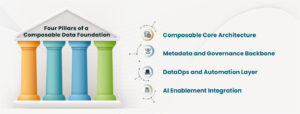
Together, these pillars address the real constraint facing payers today i.e., the inability to turn fragmented operational data into timely, trusted decisions.
The Shift (Why This Matters Now for Payers)
Most health plan data environments were never designed for modern use cases like:
- Near-real-time care gap identification
- Dynamic network performance management
- Value-Based Care (VBC) measurement beyond retrospective scorecards
- Predictive risk stratification across claims, clinical, and social data
Instead, they were built to answer static questions:
- CMS submissions
- HEDIS and Stars reporting
- Financial close and reconciliation
As a result:
- Claims arrive late and incomplete
- Clinical data is episodic and inconsistently structured
- Vendor-owned platforms restrict access to raw data
- Analytics teams depend on manual extracts and custom logic
Industry studies show that over 70% of enterprises struggle to operationalize AI, with legacy data architecture cited as a primary blocker. For smaller health plans, the impact is amplified: fewer resources, tighter margins, and less tolerance for failed pilots.
This is why modernization is shifting away from monolithic warehouses toward composable, metadata-driven architectures including data lakes, lakehouses, and enterprise data fabrics. These architectures unify access, automate governance, and make data usable without requiring massive team expansion.
The Four Pillars of a Composable Data Foundation
- Composable Core Architecture
From static reporting to adaptive intelligence
Modernization for health plans is not a “rip and replace” exercise. It is a progressive evolution:
Data Warehouse → Data Lake → Lakehouse ↔ Data Fabric
For payers, this means:
- Decoupling compute from storage so analytics costs scale predictably
- Unifying claims, eligibility, provider, care management, and SDOH data
- Supporting both batch (claims) and near-real-time (ADT, care events) ingestion
- Avoiding lock-in to any single analytics or vendor ecosystem
An API-first, modular architecture allows data to flow across clinical, network, finance, and operations teams, without duplicating logic or rebuilding pipelines every time a new program launches.
- Metadata and Governance Backbone
Trust is the real bottleneck—not data volume
In most health plans, the same question gets different answers depending on:
- Which report is used
- Which vendor produced it
- Which analyst built the logic
This erodes confidence, especially in VBC, where dollars and provider relationships are at stake.
By establishing metadata as the control plane, payers can:
- Track lineage from raw claims to quality measures
- Establish canonical definitions for key metrics (e.g., avoidable ED, PMPM)
- Embed governance directly into data pipelines instead of policing it later
- Satisfy regulatory and audit requirements without slowing innovation
For smaller plans, this approach reduces dependency on tribal knowledge and creates continuity despite team turnover.
- DataOps and Automation Layer
Doing more with the same (or smaller) teams
Most payer data operations are still Manual, Ticket-driven and fragile during vendor or contract changes.
Embedding CI/CD, observability, and automation into data pipelines transforms data engineering from a reactive support function into a scalable capability.
This enables:
- Faster onboarding of new provider feeds or vendors
- Safer changes to measure logic without breaking downstream reports
- Continuous monitoring of data freshness, completeness, and quality
For plans with lean analytics teams, DataOps is not optional because it is how scale is achieved without burnout.
- AI Enablement Integration
From pilots to production
Many payer AI efforts stall because models are built in isolation, disconnected from governed data pipelines and operational workflows.
By extending the data foundation with feature stores, model pipelines, and vector databases (for unstructured data like notes or authorizations) health plans can enable:
- Predictive risk models grounded in trusted data
- Generative AI use cases (member communication, care navigation)
- Secure deployment within regulatory and privacy boundaries
By applying these principles, AI becomes a natural extension of the data ecosystem, not a separate experiment.
The Value
Health plans that adopt this four-pillar approach can expect:
- Faster time-to-insight without increasing headcount
- Improved confidence in network and VBC analytics
- Reduced operational friction during vendor transitions
- A scalable foundation for quality, cost, and experience optimization
A composable, metadata-driven architecture leveraging platforms like Azure, Snowflake, and Databricks creates a living data foundation that adapts as regulatory, clinical, and market conditions change.
Why This Matters for Payers
Larger national plans can absorb inefficiency. Smaller plans cannot.
For community-based payers, modernization is not about competing on sophistication, it is about:
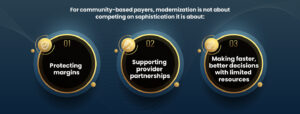
Organizations that modernize with intent will build trusted intelligence and avoid being forced into reactive decisions driven by vendors rather than strategy.
What’s Next?
Architectural inertia is no longer neutral, it is a liability.
Health plan leaders should begin with an Enterprise Data Strategy Assessment that reflects their scale, constraints, and regulatory realities.
OwlSure partners with health plans to modernize data foundations, unify fragmented data estates, activate analytics and AI—without overengineering or causing disruption.
👉 Learn how OwlSure helps health plans turn data into decisions.