

Executive Summary
As enterprises accelerate their adoption of analytics, BI and AI initiatives, a fundamental truth is emerging: context is what makes the difference between intelligence and noise. Data alone does not drive insight. It’s driven by data with context i.e., business meanings, relationships, lineage, and intent.
AI systems cannot reason over data they do not understand. Without shared semantics, consistent entities, and machine-readable metadata, even the most advanced AI models struggle with accuracy, trust, and scale. This is why Master Data Management (MDM) and active metadata are no longer just “data management” concerns—they are becoming core AI infrastructure.
Together, they can form the cognitive layer of the enterprise: the “brain” that enables AI, analytics, and decision systems to interpret, explain, and act on information with confidence.
Moving From Data-Rich to Context-Aware
Across industries, organizations are discovering that AI failures rarely stem from algorithms alone. Research consistently shows that many AI models (over 65%) fail to operationalize within specific enterprises at scale due to inconsistent business definitions, fragmented master data, and weak metadata foundations.
In contrast, enterprises that invested in context-enriched data ecosystems where meaning, relationships, and lineage are explicitly modelled, saw measurable gains (up to 2× improvement) in model accuracy, explainability, and stakeholder trust.
This trend marks a shift from:
- Volume to semantic consistency
- Siloed datasets to connected business entities
- Static documentation to active, machine-readable metadata
This shift shows enterprises moving from a state of “more data” to “more connected, contextual, and explainable data.” Any future-ready data foundation that enterprises strive towards, is not just integrated, it needs to be context-aware by design.
Mastering Context Through MDM and Metadata
In our AI and modernization programs for OwlSure customers across Insurance, Healthcare and Banking, we consistently observe that pilots stall or misfire not because of model complexity. The root cause is rarely model sophistication. It is because most of the data that is applied, lacks shared meaning. Customer data is duplicated, product hierarchies are inconsistent across domains, and metadata exists, but only as passive documentation. AI systems are left to infer meaning, often incorrectly.
To address this, organizations must deliberately architect for what we call “context intelligence”. At the core of this approach are 4 architectural enablers that together establish a scalable semantic foundation.
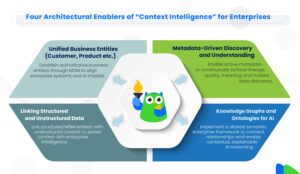
Architectural Enablers of “Context Intelligence” for Enterprises
- Unified Business Entities (Customer, Product etc.)
Enterprises need to use MDM to provide a single, authoritative representation of core business entities across operational and analytical landscapes. By resolving duplicates, inconsistencies, and conflicting hierarchies, MDM creates a trusted enterprise “golden record.”
For AI and analytics, this consistency is critical. Unified entities ensure that segmentation, risk scoring, personalization, and forecasting models are built on the same definitions, reducing variance, bias, and interpretability gaps. In effect, MDM can become the anchor point for enterprise-wide intelligence.
- Metadata-Driven Discovery and Understanding
Active metadata moves beyond static catalogs. It continuously captures and operationalizes technical, business, and operational context including lineage, quality signals, relationships, and usage patterns.
For enterprises focusing on active metadata, this enables intelligent discovery, semantic search, and automated classification across both structured and unstructured data. More importantly, it allows AI systems to understand what data represents, how it is used, and whether it can be trusted.
This way, metadata becomes the map for both users and AI systems, guiding them to the right data, with the right meaning, the right context and at the right time.
- Knowledge Graphs and Ontologies for AI
Knowledge graphs model entities, attributes and relationships as an interconnected semantic network, enabling AI systems to reason over data rather than merely process it. Ontologies complement this by defining the formal vocabulary, rules, and constraints of the business domain.
Together, they can establish a shared semantic framework across the enterprise. Ontologies provide vocabulary, structure and meaning; while knowledge graphs provide context and connectivity. Further they enable contextual search, grounding for GenAI and recommendation logics to drive explainable decision-making. This combination forms the semantic intelligence layer that allows AI to interpret meaning rather than just process data.
- Linking Structured and Unstructured Data
A significant portion of modern enterprise knowledge resides outside structured systems: in documents, notes, logs, transcripts, claims, medical records, interactions, to name a few.
By linking unstructured content to structured MDM entities through metadata and knowledge graphs, organizations unlock context-rich views of customers, products, members, or assets. This fusion can power advanced search, copilots, decision support, and risk intelligence, allowing AI to reason across both facts and narrative.
The Value of developing a Context-First Architecture
Organizations that leverage the above concepts to treat MDM and metadata as strategic enablers consistently realize more value, through:
- Higher AI accuracy and explainability through consistent semantics
- Faster cross-domain scaling of analytics and AI use cases
- Stronger alignment between BI, analytics, and business teams
- Deeper customer and operational insights from unified entities
- Increased trust in AI-driven outputs
This way the context acts as a force multiplier within the enterprise- for every data, analytics and AI initiative.
How Data leaders get started on Mastering Context
A practical starting point is to identify where business meaning breaks down: fragmented entities, inconsistent definitions, and disconnected metadata. From there, organizations can prioritize unified entity models, activate metadata for discovery and lineage, and pilot knowledge graphs in high-impact domains such as customer, product, members, or asset.
Those that master context early will not only operationalize AI faster, but will build intelligence that is explainable, scalable, and trusted across the enterprise.
As a data leader, get started on your MDM, metadata management and modernization journey with an Enterprise Data Strategy Assessment led by experts at OwlSure. Click here to learn how OwlSure modernizes enterprise data estates, unifies data with context and enables trusted intelligence at scale.
Authors:
Venkata Bhaskar, Data Architect
Renji Krishnan, Senior Product Marketing Manager